
Indian investors have seen their wealth erode by a staggering Rs 48.29 lakh crore since the West Asia war began on February 28, leading to a significant downturn in the BSE Sensex and NSE Nifty, driven by geopolitical tensions and rising crude oil prices.

Margin Trading Facility (MTF) provides an avenue for traders to magnify their potential returns by trading with borrowed money; however, it carries inherent risks. While the lure of increased purchasing power is strong, responsible engagement with MTF requires having a clear understanding of the MTF feature. In this blog, we will explore the key do's and don'ts of those who are considering using MTF.

Indian benchmark indices Sensex and Nifty experienced a sharp decline in early trading due to escalating tensions in the Middle East, driving crude oil prices higher. Global market bearishness and foreign fund outflows further contributed to investor unease.

The Indian rupee weakened against the US dollar due to a strengthening dollar, high crude oil prices, and foreign fund outflows amid geopolitical uncertainties.

Indian stock market indices Sensex and Nifty experienced a significant drop in early trade, reversing a three-day rally. The decline was triggered by a sharp increase in crude oil prices, weak global market trends, and continuous outflows of foreign funds.

There are hopes of a turnaround in overall corporate earnings after six quarters of single digit growth.

The tax is collected by brokers on behalf of the government and forms a key component of the Centre's tax revenues.

The stock of automative major Eicher Motors hit its all-time high on Wednesday, capping the year with gains of about 52.7 per cent. It has comfortably outperformed its sector index, the Nifty Auto, which jumped 22.7 per cent, as well as the benchmark Nifty, which rose 10 per cent during this period.

The US blockade on Iranian ports is aimed to curb Iranian energy exports, thereby crippling its economy to force Iran back to the negotiating table, points out Commodore Venugopal Menon (retd).

Shares of e-commerce firm Meesho on Wednesday made a remarkable market debut by listing with a premium of more than 46 per cent against the issue price of Rs 111.

Indian equity markets experienced a significant downturn as geopolitical tensions in West Asia, rising oil prices, and foreign fund outflows dampened investor confidence. The Sensex and Nifty both fell sharply in early trade, reflecting broader global market weakness.

Sebi cautions investors against fake notices demanding Securities Transaction Tax (STT) payments and warns about fraudsters posing as account handlers promising risk-free profits.

The Indian government has doubled the daily quota of market-priced 5-kg LPG cylinders for migrant workers to ensure stable fuel supplies amidst global disruptions. This move prioritises household cooking gas and addresses the needs of migrant workers who often lack regular connections.

FSN E-Commerce Ventures, the parent company of Nykaa, anticipates its consolidated net revenue for Q4 FY26 to achieve high 20 per cent year-on-year growth, marking its strongest performance in 12 quarters, fueled by accelerated growth in both its fashion and beauty verticals.

Analysts predict that the ongoing conflict in West Asia, crude oil price fluctuations, and the US Federal Reserve's interest rate decision will significantly influence the Indian equity market this week.

Delhi Police have arrested six individuals linked to interstate cybercrime syndicates involved in digital arrest, fake IPO, and trading scams, recovering millions of rupees.

India's economy is projected to maintain growth above 7 per cent in 2026-27 (FY27), supported by strong domestic consumption and investment, even as global growth faces risks from geopolitical tensions, according to industry body Assocham.

'In investing, poor sentiment is always a good vintage to build a portfolio.'

Algo trading should be segregated in a separate account with only risk capital deployed.

The BSE Sensex and the Nifty 50 declined around 4.5 per cent each since the start of the West Asia conflict.

Global funds' assets under custody (AUC) in India have been flat this year, with a Rs 2 trillion drop in information technology (IT) holdings offset by gains in financial stocks. AUC is the total market value of equities held by FPIs.
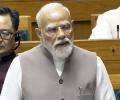
Prime Minister Narendra Modi addressed Parliament on the West Asia crisis, advocating for dialogue and diplomacy, ensuring the safety of Indians in the region, and addressing concerns about fuel and food security.

'Given that India underperformed emerging markets by 28 per cent in 2025, the worst performance in over 30 years, the timing of the sharp STT hike could have been better.'

The US Navy seized an Iranian-flagged cargo ship in the Gulf of Oman, escalating tensions as ceasefire talks face uncertainty. The incident raises concerns about the fragile ceasefire and the ongoing blockade of the Strait of Hormuz.

Saudi Arabia and the UAE are actively pushing Trump to take the war to its bitter finish and 'erase' Iran's presence in the geopolitics of the region. Simply put, the two most powerful Sunni Arab oligarchies are on the same page as Israel. Such interference increases the risk of a breakdown in dialogue between the US and Iran, points out Ambassador M K Bhadrakumar.

From the Sensex firms, Adani Ports, Bharat Electronics, Eternal, Tata Motors Passenger Vehicles, State Bank of India and Kotak Mahindra Bank were among the biggest gainers. However, ITC, Bajaj Finance, Titan and Tech Mahindra were the laggards.

The big question is whether Trump is any longer in command of the situation. For all practical purposes, the war seems set to cascade as the US is preparing for a potential ground operation in Iran and threatens to destroy 'bridges next, then electric power plants', points out Ambassador M K Bhadrakumar.

US President Donald Trump is considering ending the military operation against Iran even if the Strait of Hormuz remains closed, according to the Wall Street Journal.

From the Sensex pack, HCL Tech, Infosys, Tata Consultancy Services, Hindustan Unilever, Sun Pharma and Titan were among the biggest gainers. In contrast, Tata Motors Passenger Vehicles, Maruti, Adani Ports and Bajaj Finance were among the laggards.

Sensex and Nifty post steepest weekly loss in over a year, falling nearly 3 per cent.

After two years of strong gains, smallcap stocks fell sharply in 2025, but the correction may be setting up opportunities for long-term investors.

The Nifty IT index hit a more than nine-month low, trading at its weakest level since April 17, 2025.

Tea planters in Darjeeling have raised that a shortage of commercial LPG, triggered by the ongoing conflict in West Asia, could hit tea processing during the first flush, the delicate early-season harvest that commands the highest premiums and often sets the tone for the year.

'For the initial decade, I consistently advise young professionals to prioritise career development and income growth rather than market analysis.'

The Reserve Bank of India (RBI) on Friday delivered a 25 basis point (bps) repo rate cut analysts expected, driven by the strong 8.2 per cent GDP growth in the September quarter. However, analysts do not expect a runaway market rally as the impact of US tariffs continues.

Among major Sensex gainers Bajaj Finserv rose the most by 1.42 per cent, Axis Bank gained 0.80 per cent, Infosys by 0.72 per cent, Mahindra & Mahindra by 0.60 per cent, Tata Motors by 0.55 per cent, Bajaj Finance by 0.53 per cent and Tata Steel by 0.52 per cent. Kotak Mahindra Bank, ICICI Bank, HCL Technologies, Bharti Airtel, Maruti Suzuki India, Trent Ltd and Tata Consultancy Services were the losers.

Analysts say long-term investors may still benefit, but recommend limiting bullion exposure to around 10 per cent.

Indian equity markets closed higher, driven by gains in PSU bank, auto, and financial stocks, following the US Supreme Court's decision on tariffs. Sensex climbed 479.95 points to 83,294.66, and Nifty advanced 141.75 points to 25,713.

The benchmark BSE Sensex's trailing 12-month price-to-earnings (P/E) multiple has declined to 20.2x, its lowest since May 2020, driven by a record $42 billion FPI selloff since September 2024 and concerns over corporate earnings and economic growth.

Trade deals ease risks for Indian equities, but weak demand and stretched valuations raise questions over whether optimism -- especially in smallcaps -- can turn into a sustained bull run, points out Debashis Basu.
